

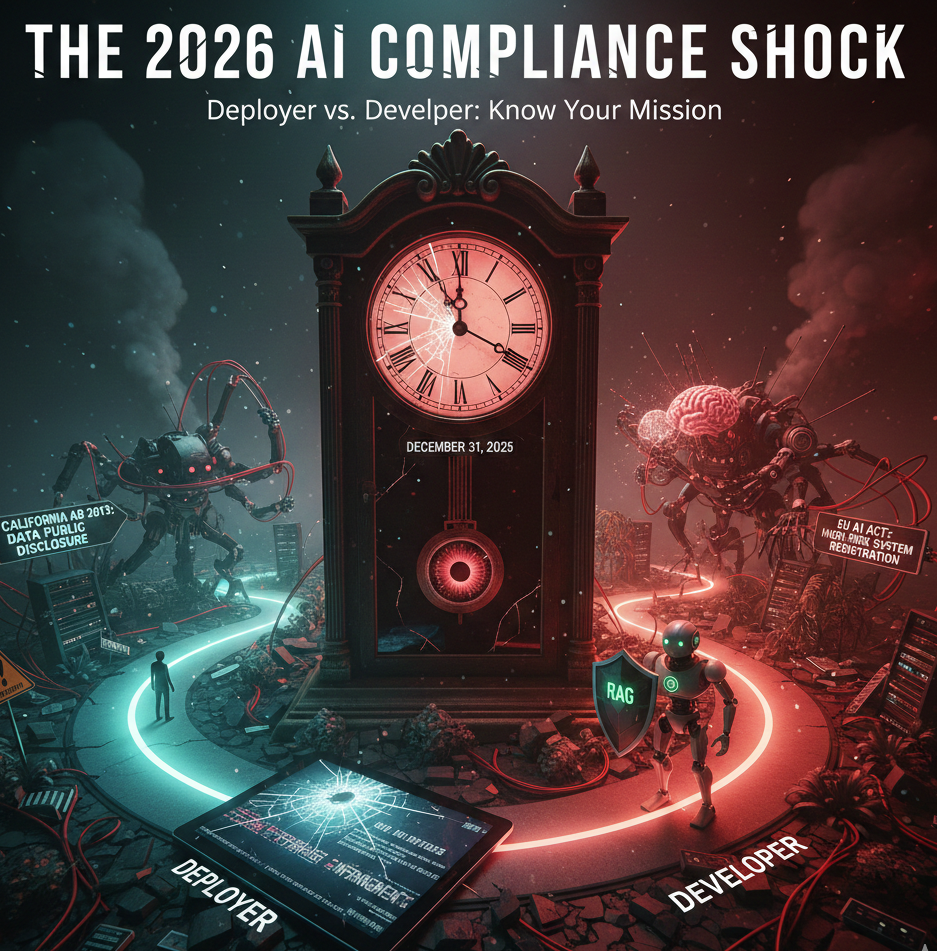
The future of your business rests on a single word. No, it's not "synergy" or "blockchain." It's a legal definition that is about to determine your compliance costs, your legal exposure, and even whether your current AI strategy is sustainable in the new age of regulation.
For the last few years, the AI world has been the Wild West—fast, unregulated, and mostly free of consequences. That time is officially over. Starting in 2026, major laws in the European Union (EU), the US (especially California), and China are slamming into effect all at once.
The most critical mission for every founder and executive right now is simple: You must correctly identify your role in the AI ecosystem. Are you a Deployer or a Developer? Choosing wrong is the difference between a moderate compliance cost and a financial catastrophe.
1. The Distinction That Defines Your Risk
Imagine AI compliance like a construction zone. Who is responsible when the building collapses? The person using the hammer, or the architect who engineered the foundation?
Here is the straightforward breakdown of the two roles:
| Role | Responsibility | The Financial Reality |
|---|---|---|
| The Deployer (The User) | You use off-the-shelf AI tools—like Microsoft Copilot, Salesforce AI, or a standard version of ChatGPT—in your business. You're the user. | LOW TO MODERATE RISK. Your main job is oversight, training staff, and maintaining transparency. |
| The Developer (The Builder) | You build an AI system from scratch, sell an AI-powered product to customers, or, crucially, significantly modify one. | EXTREME RISK. You are responsible for all testing, documentation, government registration (like the EU's CE Mark), and public disclosure reports. |
2. The Fine-Tuning Trap: The Flip Switch to Disaster
This is where many companies will make an accidental, expensive mistake.
You might assume that if you buy a model from a giant like OpenAI, they are the Developer. That's true... until you customize it.
The fatal error lies in Fine-Tuning.
Fine-Tuning means taking an existing model (e.g., an open-source model like Llama 3) and retraining its core weights—its brain—on your company's proprietary data to improve performance.
In the eyes of California regulators (and eventually the world): If you fine-tune the model, you become a Developer.
California's Catch-22 (AB 2013)
Effective January 1, 2026, California's Assembly Bill 2013 (AB 2013) demands that developers of generative AI must publish a summary of the training datasets used.
- The Risk: If you fine-tuned a model using data you scraped from the internet in 2023 without verifying copyright or licensing, you are now legally responsible for publicly disclosing that data source. You could be confessing to massive copyright infringement.
3. The Escape Route: Use RAG
Fortunately, there's an alternative that lets you achieve similar customization without accepting the Developer's burden.
The best compliance defense is using RAG (Retrieval-Augmented Generation).
RAG means you are feeding the AI your documents (e.g., your policy manual, customer service transcripts) to provide immediate context for a query. You are merely augmenting the conversation with external documents; you are not retraining the model's core intelligence.
Because you are not modifying the fundamental AI brain, you safely remain a low-liability Deployer.
"Stick to RAG whenever possible to avoid the heavy data reporting burdens of California AB 2013."
4. Immediate Action Points
You must address these two areas immediately:
A. Audit Your Existing AI Usage
Conduct an immediate, high-priority audit of all AI tools used across your business.
- Inventory: List every tool—from HR resume scanners to marketing copy generators.
- Classify: Determine the precise compliance status of each: Is it a simple Deployer tool, or are you dangerously close to the Fine-Tuning threshold?
- High-Risk Check: If you use AI for hiring or credit scoring, those systems are immediately deemed High-Risk by the EU AI Act and trigger laws in states like Colorado and Illinois.
B. Prepare Your Legal Shield
Every Deployer needs a documented defense (your "Reasonable Care" defense):
- Human Oversight: Implement a mandatory process for keeping a human in the loop. The AI can recommend rejecting an application, but a person must review and finalize the decision. If you skip this, it is non-compliant "automation bias".
- Archive Prompts: Treat prompts like legal documents. In a lawsuit, the prompt you used is evidence you attempted to prevent bias.
- Update Policies: Your internal "Acceptable Use Policy" must explicitly prohibit employees from using personal, unapproved Shadow AI tools, which are major data leak vectors.
The clock is ticking. The Regulatory Singularity is not a future threat; it is a fixed date on the calendar, and the requirements are already setting the legal groundwork for how you will operate in 2026.
Ready to Get Your Team Compliant?
BaseState provides the training and certification your team needs to navigate 2026 regulations.
Get Started Today